
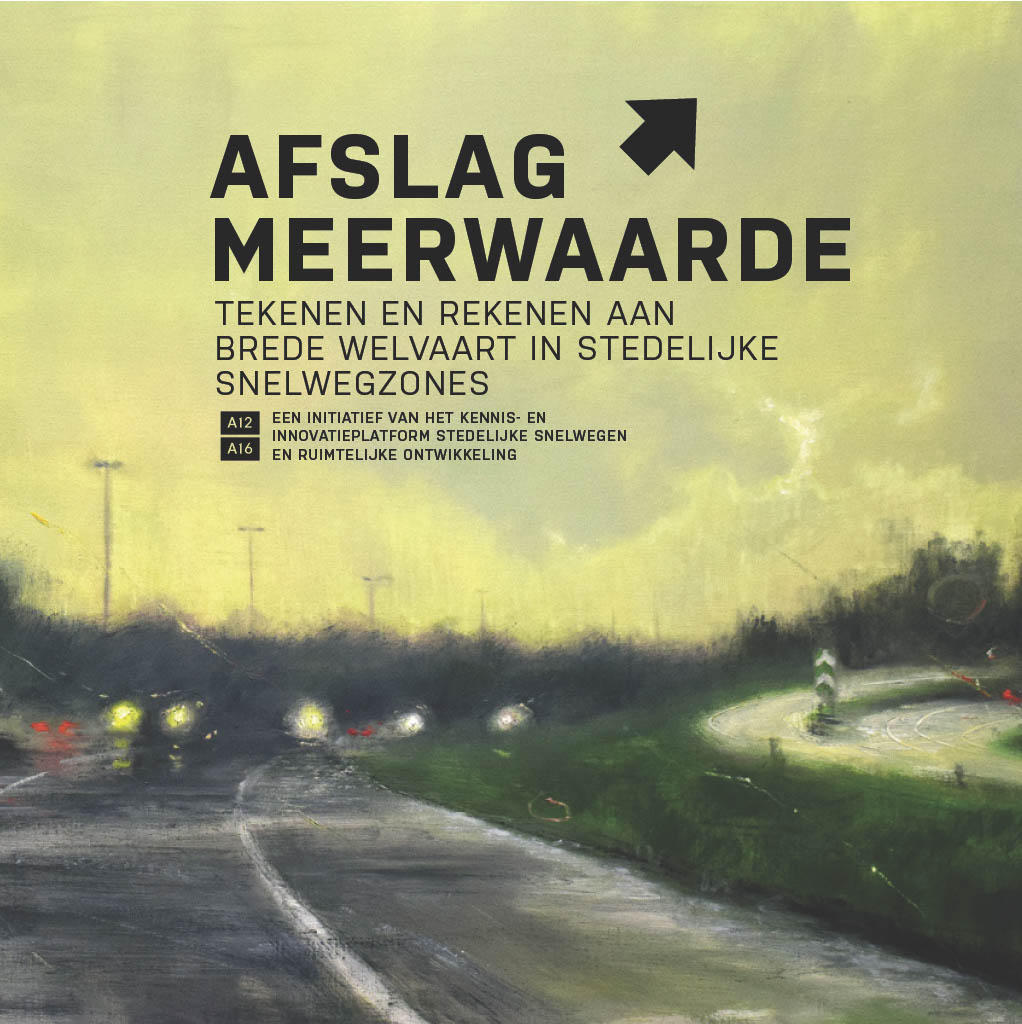
Afslag Meerwaarde
(NL), 2025
Information
How can we transform urban motorways and railway infrastructure into healthy neighbourhoods?
As the economies of metropolitan areas continue to grow, and the demand for housing, workspace, facilities, public space, nature, and mobility continues to rise, space becomes increasingly scarce. Transformation of infrastructural areas with railway tracks and motorways offers many opportunities to address the challenges, especially if this is combined with a modal shift strategy that prioritizes walking and cycling.
On this subject, VenhoevenCS and De Zwarte Hond completed a research-by-design study for the SSRO Association. The study explored how the A12 corridor between The Hague and Zoetermeer could evolve from a mono-functional infrastructure zone into a well-connected urban landscape that supports sustainable mobility, spatial quality and sustainable urban development.
We explored three alternative scenarios for the mobility infrastructure with related social and cultural benefits, economic benefits and ecological benefits as key elements of a multi-purpose transformation.
Developments like these require substantial financial investments. Parts of these are generated by the business case, others can be subsidised by local, provincial and central government, provided societal benefits outweigh societal costs. However, in complex projects like these, this public funding may not be sufficient. Such projects generate both direct and indirect value. There are revenues from land development but also increased appreciation in the value of surrounding real estate, reduced pressure on the healthcare system due to improved mental and physical health and lower costs within the social domain through safer public space. Our project identifies multiple values that can be enhanced through spatial planning and stakeholders that might be interested to invest in these. This way new forms of financing for complex transformations like these are explored to improve feasibility.
Method
The project explored future development potential of the A12 zone with a broad group of stakeholders including the three municipalities along the corridor, experts and local stakeholders. SSRO initiated the process by identifying the existing qualities and future ambitions for the corridor in sessions with all involved parties. These insights formed the basis for the development of spatial scenarios and tailored strategies for the area. Based on our MicroCity model and expert input, we explored three possible future scenarios focused on creating healthy living environments for residents, while strengthening connections between mobility, housing, public space, landscape and ecology.
Key insights
- Transformation of mobility infrastructure into high density urban development strengthens the agglomeration power of the entire Rotterdam-The Hague Metropolitan Area, contributes to the development of a strong public transport network and reduces commuter traffic.
- The area offers strategic locations for future mobility hubs that combine public transport, cycling networks, shared mobility and local facilities which can reduce the traffic on the A12.
- Investments in public transport, partial covering of the A12 and railway infrastructure, and the development of stations as mobility hubs can significantly improve spatial quality and accessibility, as well as generate long term economic, ecological, social and cultural value.
- Long term positive impact increases further when existing neighbourhoods are transformed and densified into 15-minute neighbourhoods, where daily amenities are within walking or cycling distance. This will decrease the commuter traffic even further.
- Long-term transformation requires collaboration between governments, market parties, knowledge institutions and local stakeholders, supported by shared ambitions and integrated spatial strategies.
Results
VenhoevenCS developed spatial scenarios and design strategies for the A12 corridor that demonstrate how infrastructure can become a catalyst for sustainable urban development. The findings were combined with a parallel study on the A16 to form the basis of the publication Afslag Meerwaarde, which presents new perspectives on the future of urban motorway zones in the Netherlands.
The study shows how integrated spatial and mobility strategies can improve accessibility, spatial quality and quality of life along the corridor. At the same time, it establishes a framework for future collaboration and value-driven development around major infrastructure networks.
Statistics
| Name: | Afslag Meerwaarde |
| Assignment: | Research by Design |
| Period: | 2024-2025 |
| Status: | Completed |
| Client: | SSRO Association (Vereniging SSRO, Stedelijke Snelwegen en Ruimtelijke Ontwikkeling) |
| Publications: | Afslag Meerwaarde |
Credits
| Partner architect: | De Zwarte Hond |
| Other: | Vereniging Deltemetropool, TU/Delft, Rebel |